








THANK YOU, SPEAKMAN
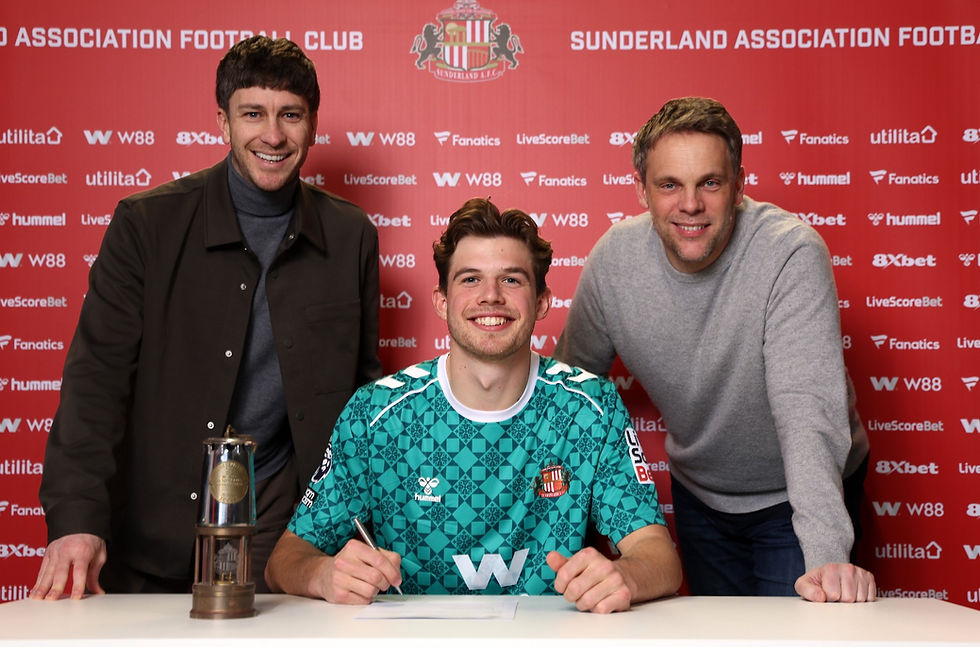
Sunderland AFC have today confirmed that Kristjaan Speakman has left the club with immediate effect; after five plus years on Wearside, he leaves as one of the key figures in our club’s resurgence.
Arriving in December 2020 (the same month Kyril Louis-Dreyfus bought the club), Speakman led the drastic change in our recruitment strategy, which has been one of the main factors in returning to the Premier League.
After years of signing players without clear thought as to how they shape the future of our club or how they fit into our specific squad, Kristjaan ensured we focused on recruiting younger and more versatile players, as well as balancing the age of the squad out more evenly. Speakman also stated, during a private talk-in at the Stadium of Light alongside Stewart Harvey in October 2021, that the club were now aiming to recruit players who were ‘good people’ and who he’d be confident in their willingness to part-take in events such as said talk-in.
Carl Winchester, therefore, was a perfectly fitting fist acquisition for the ex-Birmingham City academy manager. Despite being 27 years of age at the time of joining the lads, Winchester’s versatility was imperative to our promotion from League One, which occurred in his first full season as a Sunderland player. Having joined as a midfielder, the Northern Ireland international was exceptional at right-back the following year, whilst also featuring as a centre-half.
Ross Stewart also joined that window, for an initial reported fee of around £300,000; the Scotsman then went on to score 26 goals in all competitions the following season and was eventually sold to Southampton for a deal worth up to twelve million pounds. Comparing that to us paying a staggering four million pounds for Will Grigg on deadline day in January 2019, more than quadrupling the league one transfer record fee, Speakman’s new plan was everything that the previous regimes hadn’t been.
Speakman also oversaw the signing of Jack Clarke (who cost us three million pounds and we sold for a deal rising to twenty), Trai Hume, who also arrived for around £200,000 and is now a Premier League regular, and captain, Jobe Bellingham (who made us over thirty million pounds of pure profit and was a key figure in last season’s promotion-winning campaign).
Speakman did come into question, in particular, during our three year stint in the championship. After qualifying for the play-offs only a year after our initial promotion, it felt as if we were only a few singings away from gaining promotion to the Premier League. Joe Gelherdt lacked the physicality that Stewart and Simms offered us (who were sold and called back to Everton respectively) and, due to defensive injuries, we had to use Hume, O’Nien and Gooch as a back-three against Luton Town in the play-offs. The following summer then saw us recruit more players who we were hoping could be ‘one’s for the future’ as opposed to pre-established professionals with plenty of experience. Eliezer Mayenda, Luís Hemir Semedo, Nazariy Rusyn and Mason Burstow were all recruited in an attempt to resolve our striking options, with all of them failing to make an impact during their first season.
Upon reflection, we were obviously playing a longer game. Signing unproven players who have the potential to become superstars ensures we avoid paying extortionate and inflated fees, as well as giving us the opportunity to make hefty profits on players to aid the club’s financial health. That was the plan of KLD and Speakman when they arrived on Wearside. We ended up getting promoted from the Championship after just three years, having not spent much money to do so. This set us up perfectly for our first transfer window as a Premier League club since Speakman arrived on Wearside, and his final chapter at the club…
Our strategy of recruiting players with less experience in the English game continued in the summer, targeting players who had performed well elsewhere in Europe. Whilst Florent Ghisolfi was appointed as our new director of football on the 2nd of July, seeing Speakman move to ‘sporting director’, Speakman still would have played a major role in overseeing our summer recruitment, which saw us sign the likes of Naoh Sadiki for less than twenty million pounds and Robin Roefs for less than an alleged ten. Said duo, along with many others, are likely to be sold for more than treble what we paid for them in the next few years, or stay and become Sunderland legends, allowing us to continue to invest in our pursuit of more success.
It’s also important to reflect on why we were able to spend so much money in the summer. Unlike when we were previously in the Premier League, rules relating to how much one is allowed to spend are so much tighter, ensuring clubs have to prove where their money has come from and preventing them from simply spending however much they want to. By only paying nominal fees for players during our time in the championship, we were allowed to spend a lot more money when we arrived in the Premier League. High profit margins on aforementioned players, along with claiming 100% profit on the sales of Tommy Watson and Jobe Bellingham (owing to them being classed as home-grown talent), gave us a much greater budget for when it really mattered, and that has paid off.
There have been plenty hits during his time at the club, as well as quite a few misses. Whilst we have to credit him and the club on finding Regis Le Bris, it’s also only fair to remember the same people appointed Michael Beale. You could also say that for every Jack Clarke, there is a Leon Dajaku, or for every Dennis Cirkin, there has been an Arthur Masuaku.
He’s certainly done more right than wrong, however, and deserves major credit.
He divided the fan base throughout his time at Sunderland AFC, but he leaves the club in a much better place than what he found it in, and has to be remembered as one of the key figures in our meteoritic rise. He’s now arguably a victim of his own success, possibly having been moved on due to the positive position we now find ourselves in and desire to improve even further. Whilst it’s easy to only remember the moments on the field, we cannot underestimate the tremendous effort that has happened behind the scenes to make those moments possible. Thank you for your efforts Kristjaan, and all the best of luck in the future.


