








A GOONER'S FIRST MEMORY OF SUNDERLAND
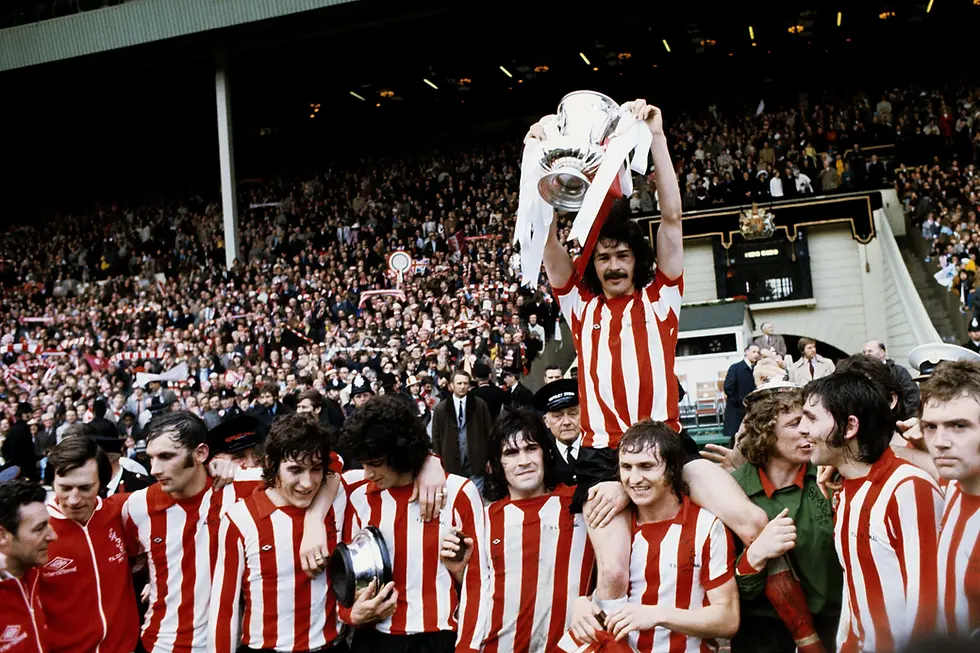
I’m 58 now, and I’ve been watching and playing football for over 50 years. It’s only while writing this that I realised the 1973 FA Cup Final — Sunderland v Leeds United — is the first football memory I have. It’s rooted in my mind, and every now and again I travel back to it.
I remember sitting on my dad’s lap, holding one of those orange lightweight plastic footballs — the kind that could change direction completely if the wind caught it. If I’m honest, my loyalties that day were firmly with Leeds United, and in particular Billy Bremner. I was so taken with him that I even wrote to a certain TV programme hoping to meet my first footballing hero.
What I remember most is the way my dad would sweep me up into the air whenever something exciting happened. Even though there was only one goal, I remember flying through the air more than once — which I now put down to Jim Montgomery’s double save, a moment that still gets replayed every time the FA Cup comes around. I don’t know if my memory of Bob Stokoe dancing across the grass is real or something that’s evolved from watching the highlights over the years, but it’s there all the same.
Around that time I also became aware of collecting football cards — a huge part of so many of our childhoods. I can still feel the excitement of buying a pack of Topps cards (five for 6p, plus two bits of bubble gum), turning them over to read the appearances and goals. Names that have gone into Sunderland folklore: Dave Watson, Denis Tueart, Ian Porterfield, Pop Robson, and of course Jim Montgomery.
I had a fast‑growing collection of football annuals back then — especially the Charles Buchan Football Annuals — and that’s where I first read about Sunderland’s history. Names like Charles Buchan himself and Raich Carter stood out, long before I really understood who they were. I just knew they meant something to the club.
Growing up in the 70s, Sunderland were one of those clubs often described as a “sleeping giant”. The teams that dominated my imagination were Liverpool, Leeds, Arsenal, and Derby County under Brian Clough — later joined by Nottingham Forest. For an eight‑year‑old in Essex, Sunderland didn’t feature much beyond being a team from the North who wore red and white stripes.
But they were never completely absent either. My friend John’s dad was a Sunderland fan, my mum’s cousin’s husband was too — he was from the area — and even now there’s a Mackem who works in my local Specsavers. Sunderland supporters were dotted around my life in small, almost accidental ways.
As for the 80s, I’m embarrassed to admit that no particular Sunderland memories stick out. They were just one of those clubs you heard on the results being read out on a Saturday evening. I remember they shared Subbuteo colours with Southampton and Sheffield United.
I wouldn’t say Sunderland have stayed with me emotionally — I’m a Gooner through and through — but I’ve always appreciated a fanbase that turns up in huge numbers, year after year, without always getting the rewards they deserve. Sunderland fans have that. Leeds fans too. There’s something about that kind of loyalty that cuts through club colours. You don’t have to support a team to recognise the strength of the people who follow it.


